
Bee Stings

Bee Stings
- Why and How Do Bees Sting?
- Video of a Bee Sting
- Why Do Bee Stings Hurt?
- How to Prevent Bee Stings
- Bee Sting Treatment
- Sting Allergies
- Apitherapy
- References and Further Reading
Why and How do Bees Sting?
Bees are crucially important for the pollination of flowering plants including many of the fruits and vegetables we eat as well the flowers we grow in our gardens. Despite the integral role of bees in many terrestrial ecosystems, many people have a fear of all things that sting. One of the most important steps to overcoming that fear is a better understanding of these insects.
Stinging insects use stingers for two main purposes: defense and predation. Honey bees and bumble bees use their stingers strictly for defense. Bees that are away from the hive foraging will rarely sting unless they are stepped on or unnecessarily aggravated. They are usually too busy searching for pollen and nectar to be bothered by a curious observer or passerby.
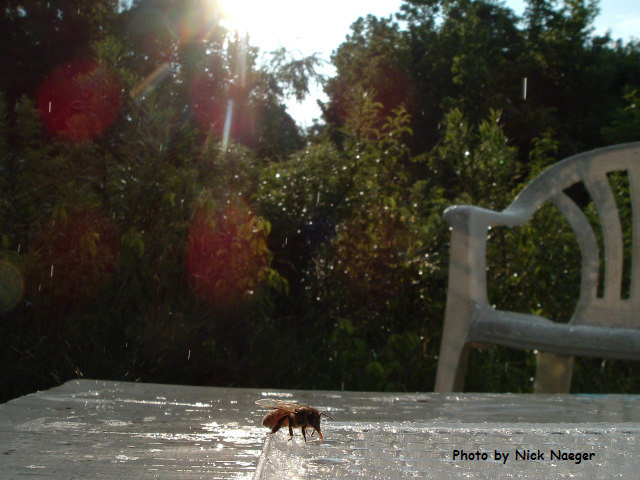
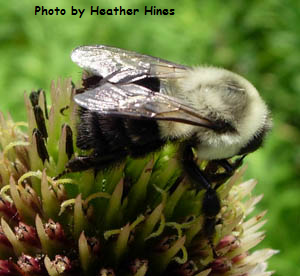
The bee stinger is a modified ovipositor, although in other insects (and in queen bees) comparable structures are used for laying eggs, in worker bees the stinger is used just for defense. Males therefore do not have stingers and pose no threat.
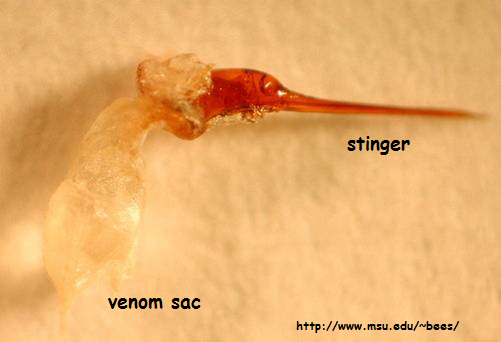
Honey bees, unlike bumble bees, can sting only one time because their stinger becomes detached after insertion. The honey bee stinger is barbed while the bumble bee stinger is smooth and allows for repeated stings. The stingers are attached to two main glands (the venom gland and the dufour's gland) that produce the mixed contents of the injected venom. A honey bee stinger continually releases venom after it is initially injected and after the stinger is detached, which is why immediate removal is recommended.
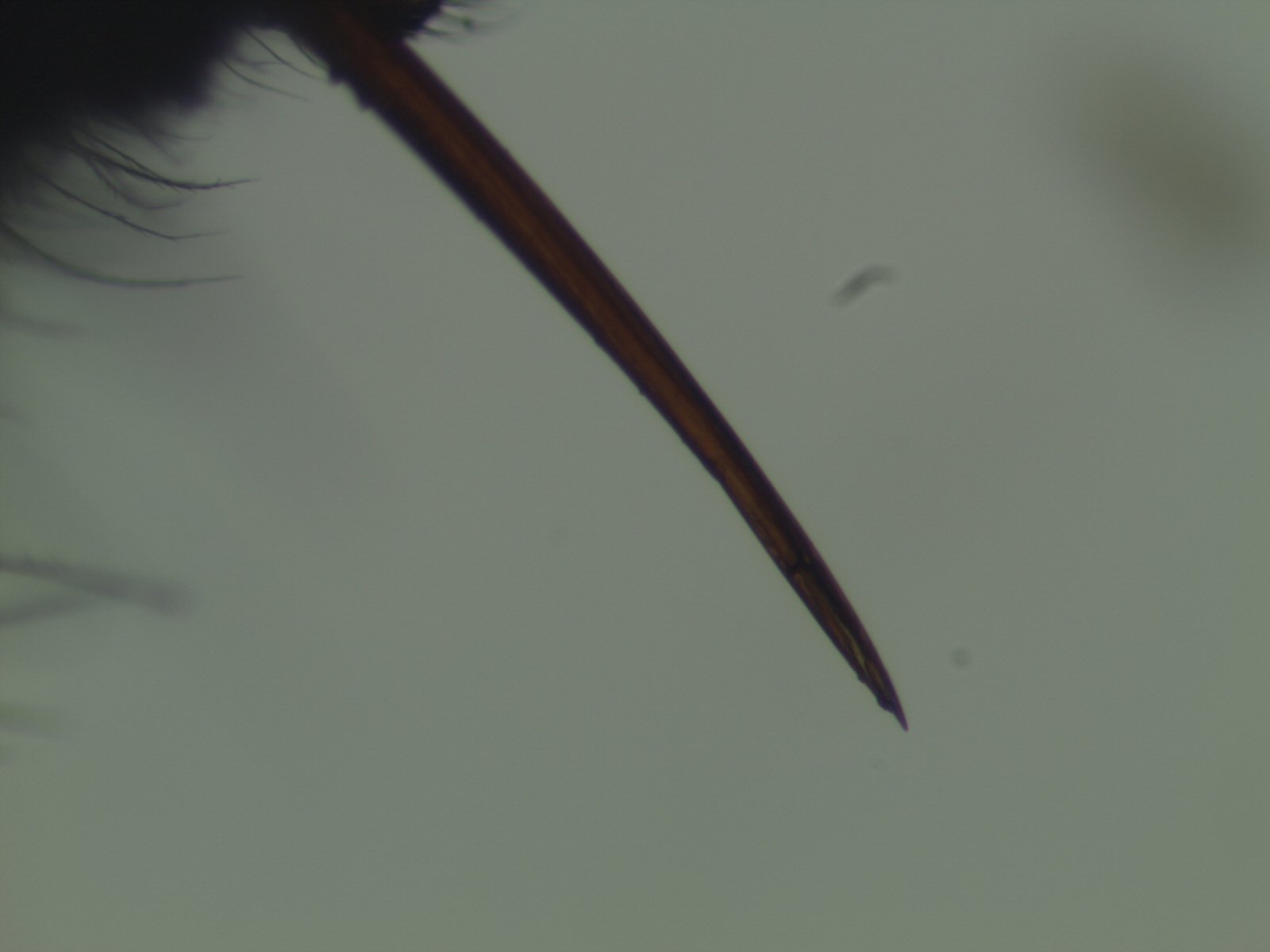
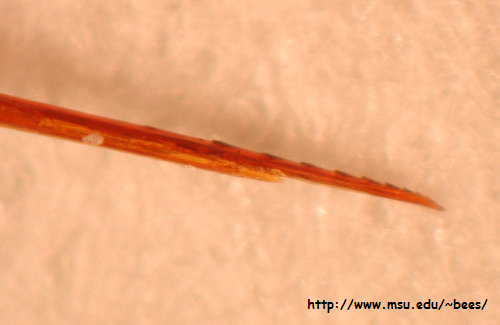
mechanism into the wound that does not permit multiple stings
Video of a Bee Sting
Here is a video of a bee stinging someone's arm.
(There is no audio, so don't worry that your speakers are turned off)
Why Do Bee Stings Hurt?
One of the characteristic properties of defensive venom is its pain-producing properties; anybody that has been stung by a bee knows this feeling well. There are three toxic effects of bee venom:
- Neurotoxic: paralysis of the local nervous system
- Hemorrhagic: increased permeability of the blood capillaries
- Hemolytic: destruction of red blood cells
The main components of bee venom that lead to pain are:
- Melittin: this peptide is a powerful anti-inflammatory agent. It binds to red blood cells and causes the release of hemoglobin into the blood plasma.
- A-Hyaluronidase: this enzyme breaks down cell components and allows toxin from the venom to spread
- Phospholipase-A: this enzyme causes the breakdown of cells and disrutps many important biochemical reactions. This is the potential cause of the actual pain experienced after a sting
Although honey bee and bumble bee venoms are not identical, many of the allergens of the venom are the same and cause similar reactions.
How to Prevent Stings
As mentioned, bees are unlikely to sting unless there is a good reason. A foraging bee will not likely be the cause of a sting unless it is stepped on or mishandled. A more likely cause of a multiple sting attack would be the disturbance of the hive.
Honey bees live in large colonies with many thousands of workers. They have an excellent communication system that uses pheromones to relay information about the environment, including intruders.
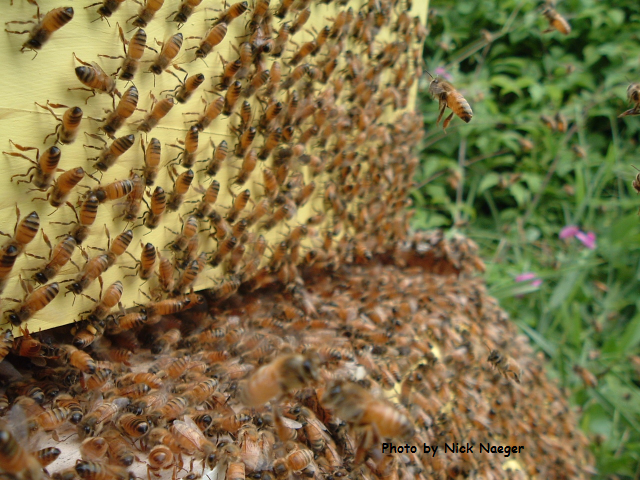
Although attacks are rare, certain precautions should be taken around a bee hive:
- STAY CALM
- Cover and protect your head; use your shirt or a towel.
- Run steadily to safety in a straight line; don’t zig-zag.
- Try to get into a sealed environment where they can’t gain entrance.
- Don’t run toward more people; that is a sure-fire way to escalate the situation.
- Don’t hide underwater; they will just be waiting for you when you come up for air.
- Don’t take your clothes off; this will just increase the skin area exposed for more stings.
- Don’t swat at the bees; this is an excellent way not only to aggravate the bees more but also to potentially crush them. If you crush a bee it releases an alarm pheromone that signals other bees, which will respond by stinging, thereby leading to a greater and more persistent attack.
If you are attacked by multiple bees:
- Be observant when using any loud equipment near a hive, especially a lawnmower. Loud vibrations and noises can irritate a colony and can cause an attack.
- Don’t use flowery perfumes, soaps, or lotions. Bees are attracted to these scents and more likely to be attracted to you.
- If a bee is near you don’t swat at it. Bees are aggravated by rapidly moving objects and are more likely to sting.
- Wear light-colored clothing; think of the appearance of a bee's natural enemy, the bear.
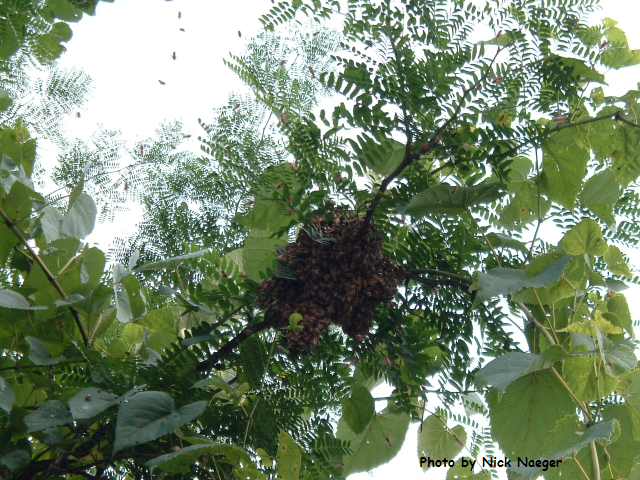
It is common to see a swarm of bees hanging in a tree. Many people view such a cluster as dangerous. In general, however, swarms are en route to a new suitable home and are very unlikely to sting. Before the bees leave their old home they gorge themselves on honey to provision the new nest; while gorged with honey, they have difficulty bending their abdomen to sting. The swarm usually doesn’t persist for a long period of time but if you are nervous or the swarm is in an uncomfortable place you can contact your local beekeeping association and they can come and relocate the swarm.
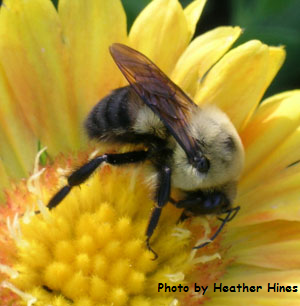
Bumble bees live in relatively small colonies and generally have a more gentle temperament than honey bees. Even if a colony launches a concerted attack, the numbers are too few to inflict much damage. As mentioned, bumble bees are able to sting multiple times; this distinction is one of the defining differences between honey bees and bumble bees. The same precautions should be observesd as for honey bees. Be aware of bumble bee or honey bee colonies near your home but do not be afraid to take a peek at their wonderful behaviors; most likely they won’t even notice you.
Africanized honey bees demand an increased level of precaution. Africanized bees are hybrids between an African race introduced into Brazil 50 years ago and the resident race of bees, originally from Europe. Africanized bees, which recently entered the U.S., are more sensitive to threats and more aggressive than the European honey bees most of us are used to. Africanized honey bees more likely to launch an attack against a perceived enemy, to attack in larger numbers, and to pursue an enemy over longer distances from the hive. Although Africanized bee venom is not more potent than European honey bee venom, the greater number of attacking bees increases the potential danger. Africanized bees are located in the southern U.S. and are unlikely to spread more northward in the near future. If you live in an area without Africanized bees today, it is unlikely they will be moving into the area anytime soon.
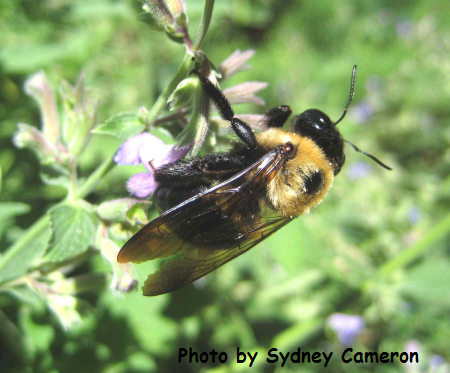
Carpenter bees, mistaken for bumble bees, are sometimes considered pests because the females construct their nests by burrowing into soft or aged wood, including wooden house frames, fences, or decks. The males of this group often fly up to people but lack any stinger with which to inflict pain. Females can sting but rarely do so unless they are handled or aggravated.
Bee Sting Treatment
A honey bee can sting only once and the stinger with the venom sac is detached from the bee’s body. The venom sac continues to pump venom through the sting into the wound. This is why it is important to remove the stinger as quickly as possible to decrease the dose of venom injected. There are many different ideas as to how to remove the stinger to limit the amount of venom received but it is common practice to scrape off the stinger instead of pulling it out because squeezing the sac to pull it out might push the remaining venom into the wound.
There are many medical and home remedies that people use to treat stings but the best course of action is just plain ice You can also take an antihistamine to reduce the swelling and a painkiller to dull the ache.
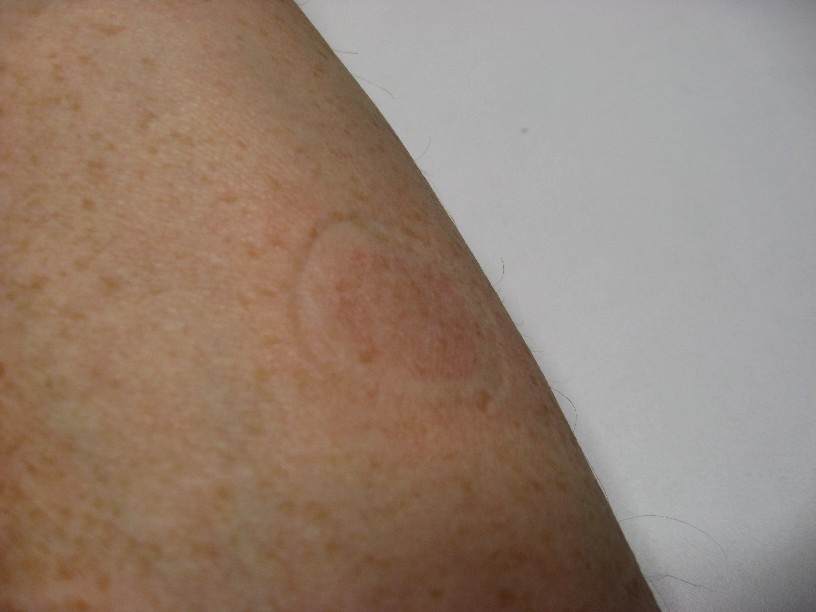
Symptoms of bee stings include: swelling, reddening of skin, itching, and a dull ache and pain in the area. These symptoms will subside within a few days, but if they do not subside or if they worsen seek medical attention. If a headache develops, or you experience nausea, vomiting, swelling of the throat, difficulty breathing, cramps, or drowsiness, seek medical attention.
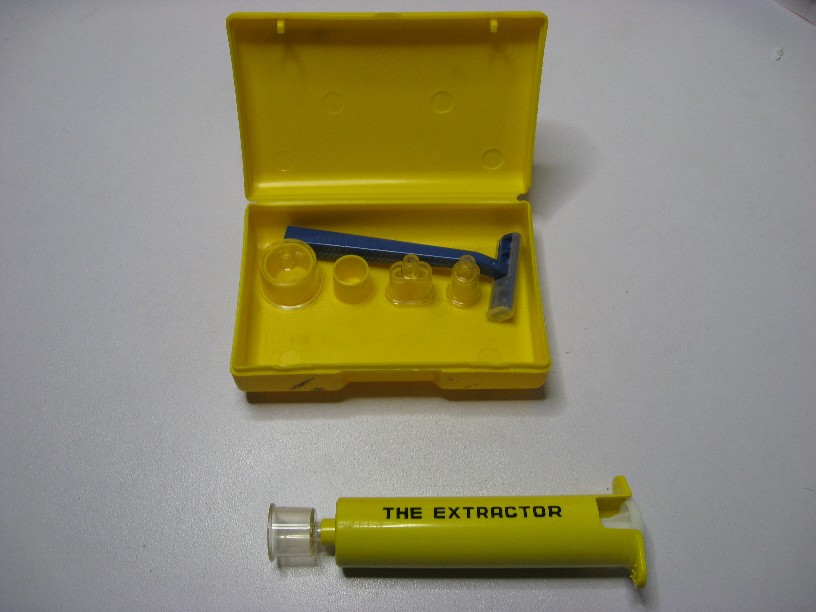
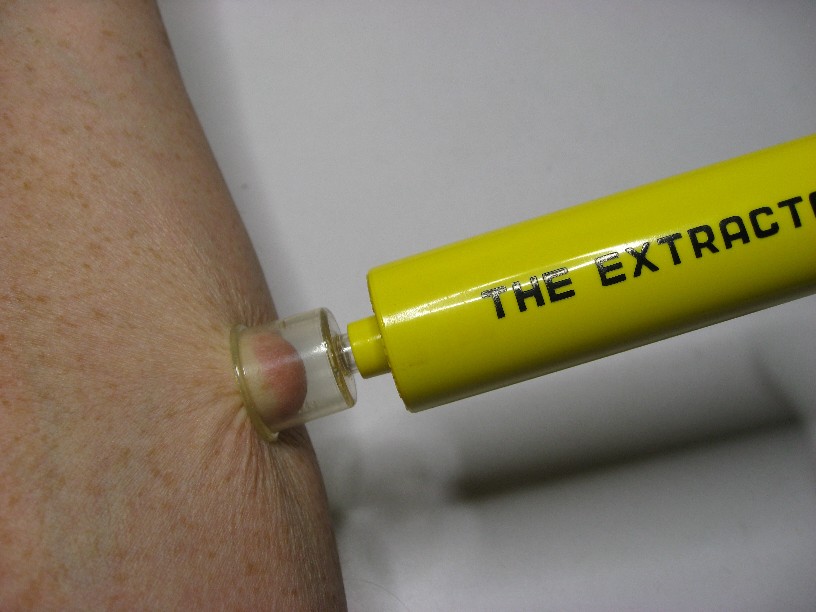
Bee spotter John Dahlstedt brought to our attention a commercially available product called The Extractor, which uses a suction device to extract venom from bee stings. The product works like a charm according to John, who wrote, "I have personally used it on yellow jacket stings several times and always the pain was completely gone after 3-5 minutes of use. I have volunteered the use of this to many others that have been stung and it had the same positive effect on them. If there is a stinger present, it of course should be removed first." We do not wish to condone one product over others, merely to convey useful information based on personal experiences. If you have had good experiences with other bee sting treatments, please let us know!
Gallery of photos demonstrating The Extractor

Sting Allergies
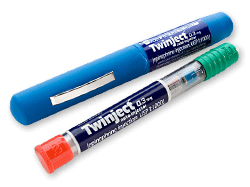
Most people have mild reactions to bee stings but a small percentage of the population is hyper-sensitive and can have a severe allergic reaction called anaphylactic shock. This reaction can be life-threatening and should be treated as quickly as possible. An allergic reaction to a bee sting often begins with a dry cough, eye irritation, or hives, and progresses to difficulty breathing, tightness in the chest, and loss of consciousness. Anaphylactic shock can lead to death unless emergency medical treatment is administered. Those people who are allergic to bee stings should not only avoid situations where they can get stung but should also carry with them an autoinjector that injects a shot of epinephrine, a hormone that stimulates the heart and relaxes the airways.

People who are allergic to stings can undergo a desensitization program where a series of injections of venom are administered at increasingly higher doses until the body becomes tolerant. This process takes months to complete but has a high success rate. This program should be administered by a registered physician and should not be attempted on your own.
Apitherapy
Apitherapy is the medical use of honey bee products such honey, propolis, pollen, royal jelly, and bee venom. The practice of apitherapy, mostly the consumption of bee products, has been used for thousands of years. In modern times the use of bee venom to treat arthritis, bursitis, tendonitis, and scar tissue has become popular. Although many patients and physicians support the healing properties of bee venom, its validity as an effective treatment option is still debated.
As mentioned, exposure to venom can be dangerous and consulting a registered physician is absolutely necessary before starting any venom regimen; caution should be taken whenever dealing with venom.
References and Further Reading
Alford, D.V. 1975. Bumblebees. London: The Trinity Press.
Kearns, C.A., Thomson, J.D. 2001. Natural History of Bumblebees. Boulder, CO: University Press of Colorado.
Lensky, Y., Mizrahi, A. 1997. Bee Products: Properties, Applications, and Apitherapy. New York: Plenum Press.
Needham, G.R. 1988. Africanized Honey Bees and Bee Mites. West Sussex, England: E. Horwood; New York: Halsted Press.
Snodgrass, R.E. 1925. Anatomy and Physiology of the Bee. New York: McGraw-Hill Book Company.

